
Homeschool Science: A Curriculum Guide
Choosing a science curriculum means deciding how your child will encounter the natural world — through hands-on experiments, living books and nature journals, structured textbooks, integrated projects, video instruction, or rigorous lab courses. Each approach shapes whether science feels like discovery or like memorization.
What families need from science shifts as children grow — elementary science is about wonder and discovery, middle school builds systematic knowledge, and high school demands lab science that holds up on college transcripts. Worldview matters more in science than in almost any other subject, and we note honestly in each description below which groups skew toward a particular perspective. Use the worldview filter to focus on options that match your family.
This page features approximately 35 editorially curated programs chosen for the quality of their science instruction. For the full list, including comprehensive programs that cover science alongside other subjects, use the Browse All link below.
This page features 33 editorially curated programs chosen for the quality of their science instruction. To see the complete catalog, including comprehensive programs that cover science alongside other subjects, browse all 152 science-related offerings.
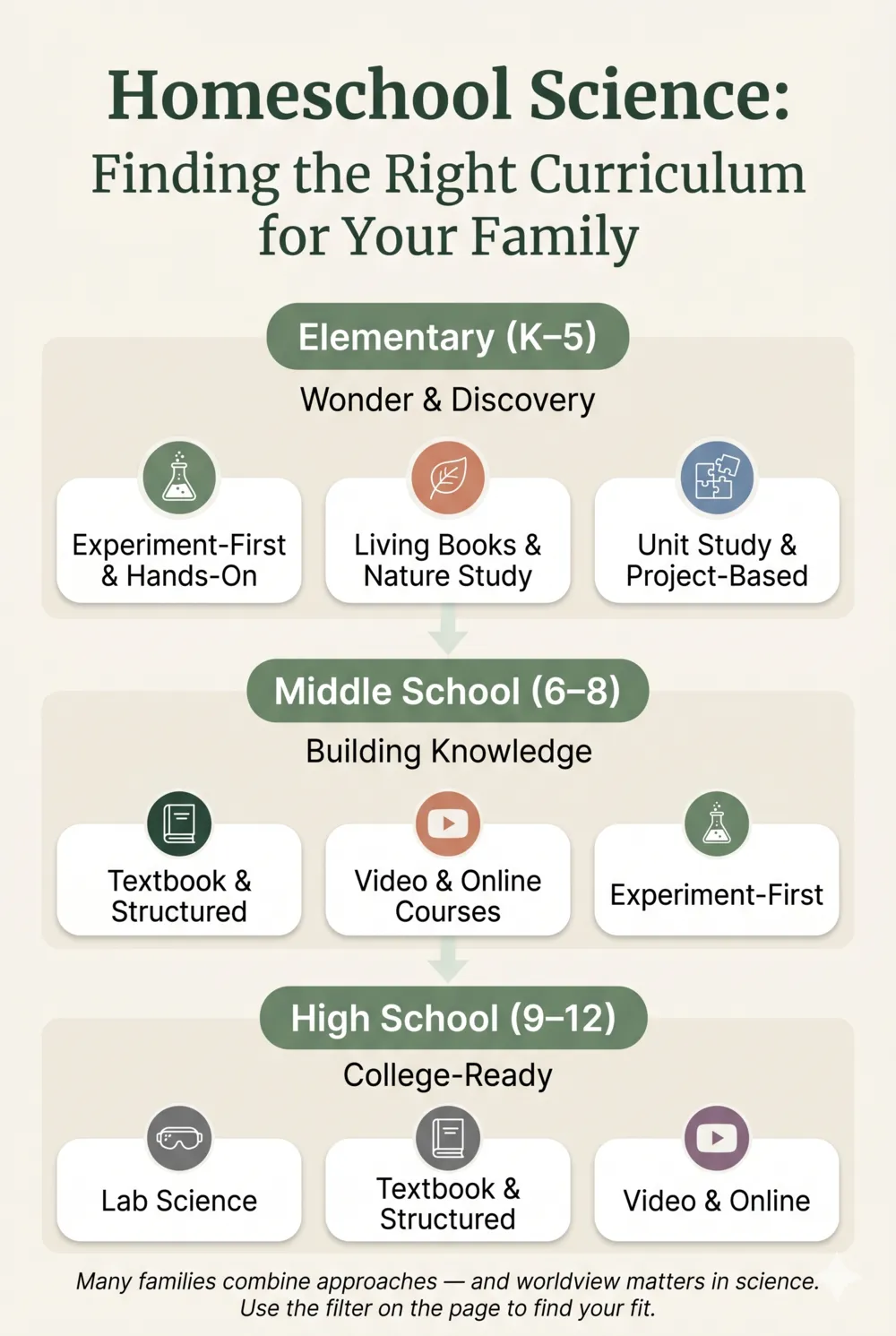
Quick Comparison
| Approach | What It Develops | Grades | Parent Role |
|---|---|---|---|
| Experiment-First & Hands-On | Scientific method intuition, observation skills, hands-on problem-solving | K-10 | Moderate — experiment facilitation and prep |
| Living Books & Nature Study | Observation skills, scientific illustration, nature literacy, curiosity | K-8 (thins out at high school) | High for younger, moderate for independent readers |
| Textbook & Structured | Content mastery, study skills, scientific vocabulary, test readiness | K-12 | Low to moderate — students read independently; parent grades tests |
| Unit Study & Project-Based | Cross-curricular thinking, research skills, creativity | K-8 | High — significant preparation and facilitation |
| Video & Online Courses | Independent learning, note-taking, content knowledge from experts | K-12 (Generation Genius K-8, others 6-12+) | Low — monitoring completion and grades |
| Lab Science (High School) | Lab technique, formal scientific reporting, college readiness | 7-12 | Low (instructor-graded) to moderate (self-paced) |
Science is one of the most worldview-sensitive subjects in homeschool curriculum. Programs that teach mainstream science follow the scientific consensus on evolution, deep time, and cosmology. Programs that teach from a creation perspective interpret the same evidence through a biblical framework. The editorial descriptions above flag which perspective each group leans toward, so you can find programs that match your family's values. Use the worldview filter to find curricula that match your family's perspective.
Understanding the Approaches
Experiment-First & Hands-On
Experiment-first programs lead with doing — students start by observing, building, or testing before they encounter vocabulary and formal concepts. The idea is that children who have already held a magnet, mixed chemicals, or dissected a flower understand the textbook explanation at a deeper level because they've experienced the phenomenon firsthand.
This is the approach that best answers the most common question new homeschool parents ask about science: "How do I actually do science at home?" Programs in this group range from video-guided inquiry (Mystery Science poses a question, then guides an experiment) to physical kit subscriptions (MEL Science and KiwiCo ship materials to your door) to comprehensive experiment-driven curricula (R.E.A.L. Science Odyssey organizes full-year courses around hands-on investigation).
What a day looks like: A Mystery Science lesson (30-45 minutes): the child watches a 5-10 minute video posing a driving question — "Why are so many things made of plastic?" — followed by a brief discussion, then a hands-on activity using common household materials. A R.E.A.L. Science Odyssey day follows its namesake structure: Read about a concept, Explore through a lab activity, Absorb by completing a lab sheet using the scientific method, Learn by reviewing the concepts. MEL Science and KiwiCo sessions center on a shipped kit — the child follows instructions to build or experiment, then reads the science behind what happened.
Living Books & Nature Study
Living books programs teach science through real books — narrative nonfiction, field guides, and beautifully illustrated references — rather than textbooks. Rooted in the Charlotte Mason education tradition, this approach pairs reading with nature study: regular outdoor observation, nature journaling, and hands-on encounters with the natural world. The philosophy is that children who read about a real scientist's discoveries and observe nature firsthand develop a deeper relationship with science than those who memorize textbook definitions.
These programs tend to integrate well with other Charlotte Mason subjects (history through living books, narration, short focused lessons) and are especially popular for elementary science, where structured textbook work can feel premature. The trade-off is that these programs thin out at the high school level, where lab science and formal coursework become important for college preparation.
Note: AmblesideOnline is a free Charlotte Mason curriculum framework that recommends science books and nature study schedules but does not include its own lesson plans or experiments — think of it as a curated reading list rather than a packaged curriculum. It's included here because it's the most well-known Charlotte Mason resource and an excellent starting point for families interested in this approach.
What a week looks like: A typical Elemental Science week: read a section from a living book like an Usborne science encyclopedia (15-20 minutes), the child narrates back what they learned, then sketches in a science notebook or nature journal. Later in the week, a simple hands-on experiment or outdoor observation activity ties back to the reading. Weekly nature walks with journal entries are a staple of this approach — the child draws what they observe, labels parts, and notes the date and weather. Blossom and Root follows a similar rhythm with seasonal nature study woven through the year.
Textbook & Structured
Textbook programs provide the most familiar format: a text with chapters, review questions, vocabulary lists, and tests. Lesson plans are laid out clearly, and progress is easy to measure — making this the go-to approach for families who need grade-level assessments for state requirements, want predictable daily structure, or are coming from traditional schooling and want something recognizable.
This group has the strongest worldview divide of any science category. Six of seven programs are published by Christian companies — and the theological range matters. Apologia, Berean Builders (by Jay Wile), BJU Press, and Master Books teach from a young-earth creation perspective — the belief that God created the universe in six literal days roughly 6,000-10,000 years ago — and present this framework alongside their science content. Novare Science is also Christian but accepts mainstream scientific dating (old-earth), offering a distinct alternative for Christian families who don't hold a young-earth position. CK-12 is secular and fully aligned with Next Generation Science Standards (NGSS). If you're looking for secular textbook-style science, also check the Video & Online group below.
What a day looks like: A high school Apologia day: the student reads a section of a module independently (20-30 minutes), works through "On Your Own" comprehension questions, and performs one or two experiments per module from the lab manual. A module test covers vocabulary, concepts, and application. At the elementary level, Master Books uses shorter daily lessons with a Charlotte Mason influence — read a few pages, answer narration-style questions, do a simple activity. CK-12 is entirely digital: students read interactive textbook sections, watch embedded videos, and complete adaptive practice problems.
Unit Study & Project-Based
Unit study programs organize science around deep topical dives that integrate multiple subjects rather than marching through a textbook chapter by chapter. A unit on the human body might include reading a biography of a medical pioneer (history), sketching anatomical diagrams (art), calculating nutritional data (math), and dissecting a sheep's heart (science) — all in the same two-week period.
This approach is particularly popular with multi-age families because children of different ages can study the same topic at different depths. A unit on ecosystems works for a first-grader (nature walks, picture books, food chain diagrams) and a sixth-grader (research reports, data collection, ecosystem modeling) simultaneously. The trade-off is that unit studies require significant parent preparation and may not cover science topics as systematically as a dedicated science curriculum.
What a unit looks like: A two-week Layers of Learning unit on weather: the family reads about meteorology, builds a barometer and rain gauge, tracks local weather data on a chart, learns about historical storms, creates watercolor paintings of cloud types, and writes a report comparing two climate zones. Science is woven through every day but never isolated from other subjects. A KONOS unit on "Resourcefulness" might include studying how animals adapt to their environments, building a Rube Goldberg machine, and reading about inventions — all connected by the character trait.
Video & Online Courses
Video and online science programs deliver instruction through recorded or live video, often by subject-matter experts or engaging presenters. This is the fastest-growing category in homeschool science, driven by families who need independent learning options — either because the parent works, because they're not confident teaching science themselves, or because the child is old enough to benefit from expert instruction.
These programs vary in format: Generation Genius pairs short videos with hands-on activities for elementary and middle students. Khan Academy offers free video lessons with adaptive practice. Derek Owens provides recorded lectures with problem sets and instructor-graded assignments. Thinkwell delivers college-style video instruction. Wondrium offers documentary-quality courses on specialized topics. The common thread is that the screen does the teaching while the parent monitors progress.
What a day looks like: A Generation Genius session (30-40 minutes): the student watches a 10-minute video featuring a real scientist explaining a concept through demonstrations, answers discussion questions, reads a companion passage, and optionally does a hands-on activity. For high school, a Derek Owens day: watch a 15-20 minute recorded lecture on, say, the ideal gas law, take notes, work through practice problems, and submit a homework assignment for instructor grading. Khan Academy works at any pace — a student might watch three short videos and do ten practice problems, or just drill one concept.
Lab Science (High School)
Lab science programs address the question that keeps high school homeschool parents up at night: "How do I give my child a real lab science experience at home?" These are rigorous, college-prep courses that include actual laboratory work — not kitchen experiments with baking soda, but formal procedures with proper equipment, documented in lab reports that colleges will recognize.
This matters because college admissions offices expect to see lab science on transcripts, and many homeschool families discover in 9th or 10th grade that their general science program doesn't include a lab component. The programs in this group either ship lab equipment and provide instructor grading (Clover Valley Chemistry, Clover Creek Physics) or pair video instruction with structured lab experiments (DIVE Science layers video teaching on Saxon science textbooks). Axiom Science and Physics Prep offer specialized physics courses with lab components.
What a week looks like: A Clover Valley Chemistry week: the student watches pre-recorded lectures (2-3 per week, 15-20 minutes each), completes homework problems, and periodically performs a real lab experiment with actual lab equipment — beakers, reagents, graduated cylinders. Labs are documented in formal lab reports following the scientific method. Tests and exams are graded by the instructor. A Physics Prep day: the student works through a lesson combining video explanation, problem-solving practice, and PhET (University of Colorado) simulations, building toward formal lab investigations.
Curricula by Approach
Experiment-First & Hands-On
Living Books & Nature Study
Textbook & Structured
Unit Study & Project-Based
Video & Online Courses
Lab Science (High School)
No curated programs match this filter.