
Homeschool Math: A Curriculum Guide
Choosing a math curriculum means deciding how your child will build mathematical thinking — through focused mastery of one concept at a time, daily mixed practice that revisits old topics, story-driven exploration, adaptive digital platforms, or challenging problem-solving that goes beyond grade level. Each approach shapes not just what your child learns, but how they feel about math.
Below, we organize math curricula into five teaching approaches: mastery-based (one topic in depth before moving on), spiral (daily mixed review of multiple topics), living math (story and exploration-driven), online & adaptive (self-paced digital platforms), and enrichment (above grade-level problem-solving). The right approach depends less on your child's grade and more on how they learn and what they need right now. Use the worldview filter to focus on options that fit your family.
This page features approximately 30 editorially curated programs chosen for the quality of their math instruction. For the full list, including comprehensive programs that cover math alongside other subjects, use the Browse All link below.
This page features 26 editorially curated programs chosen for the quality of their math instruction. To see the complete catalog, including comprehensive programs that cover math alongside other subjects, browse all 145 math-related offerings.
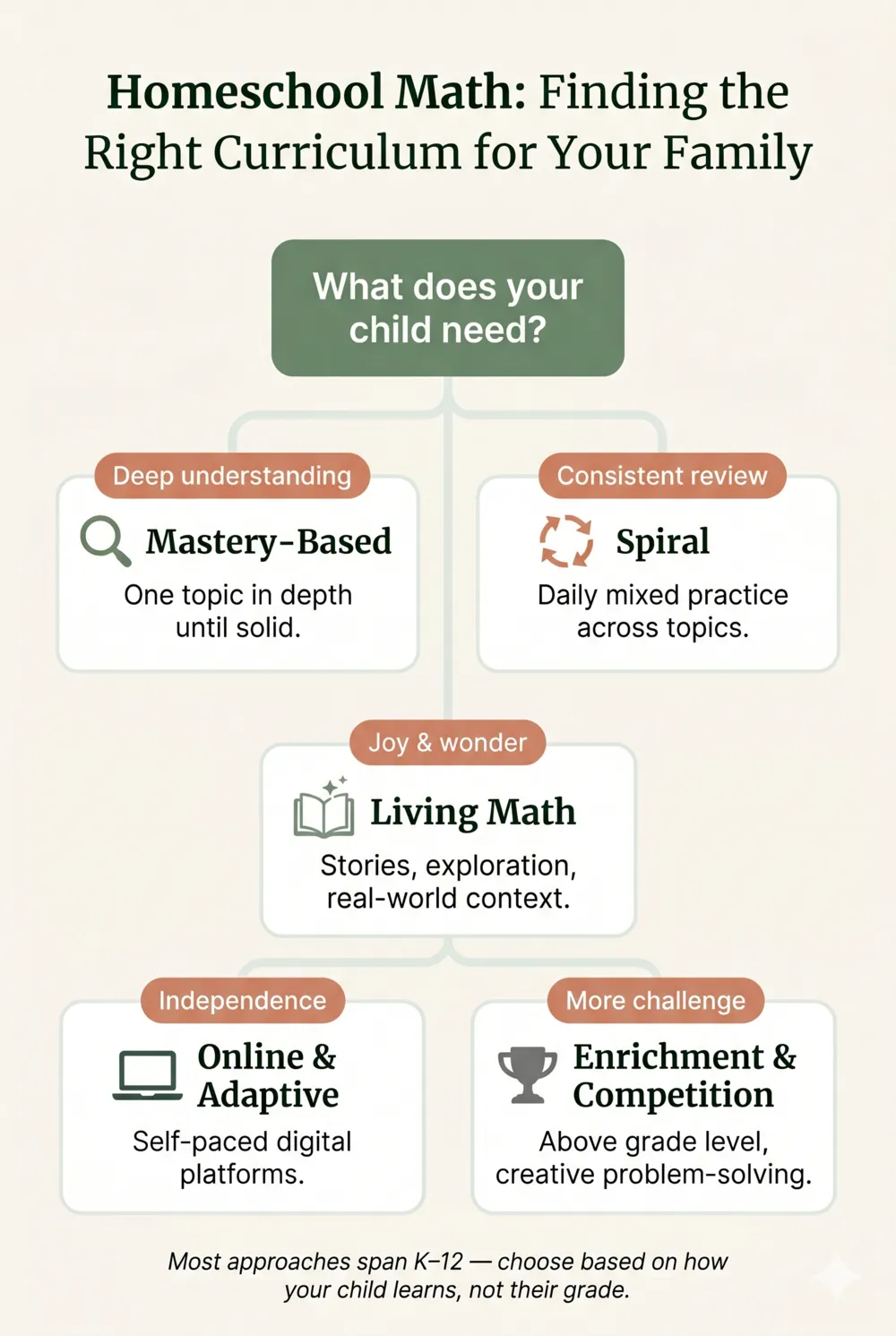
Quick Comparison
| Approach | What It Develops | Grades | Parent Role |
|---|---|---|---|
| Mastery-Based | Deep conceptual understanding, number sense, mental math strategies | K-12 | Moderate — ranges from self-teaching to daily instruction |
| Spiral | Long-term retention, mixed problem-set comfort, test readiness | K-12 | Low to moderate — Teaching Textbooks is nearly self-teaching |
| Living Math | Mathematical reasoning in context, curiosity, conceptual understanding | K-12 (Life of Fred K-Calculus; Miquon 1-3 only) | Low (Life of Fred) to High (Miquon requires facilitation) |
| Online & Adaptive | Independent learning habits, adaptive practice, self-paced mastery | K-12 (varies by program) | Very low — monitoring dashboards and ensuring login |
| Enrichment & Competition | Problem-solving stamina, creative thinking, competition readiness | 1-12+ (Beast Academy 1-5, AoPS 5-college) | Low — mostly self-teaching or instructor-led |
Math curriculum is one of the most-discussed choices in homeschooling, and the mastery vs. spiral debate can feel overwhelming. There is no universally "best" approach — what matters is the fit between how your child thinks and how the program teaches. Many experienced homeschool families switch curricula at least once, and some use different approaches for different children. If what you're using isn't working, that's useful information, not a failure.
Understanding the Approaches
Mastery-Based
Mastery-based programs teach one concept at a time, going deep before moving to the next topic. Rather than touching fractions briefly and coming back to them later, a mastery program will spend several weeks on fractions — building from concrete understanding to abstract problem-solving — before introducing the next concept.
This approach is the most recommended in homeschool communities, and Singapore Math in particular has become the benchmark that other programs measure themselves against. The key advantage is depth: children develop genuine understanding of why math works, not just how to get the right answer. The trade-off is that without built-in review, some children forget earlier material — many families add periodic review on their own.
What a day looks like: A typical Singapore Math day (30-45 minutes): the child works with physical manipulatives or draws bar models (simple diagrams that represent quantities as rectangular bars) to explore a concept, then transitions to pictorial representations, and finally works with abstract numbers and symbols. This Concrete → Pictorial → Abstract progression is what makes Singapore Math distinctive. A Math-U-See day follows a similar pattern: watch a short video lesson, practice with colored manipulative blocks, then complete a worksheet — moving on only when the child demonstrates mastery.
Spiral
Spiral programs introduce a concept, practice it briefly, then move on — returning to it again and again over weeks and months with increasing depth. Each day's work mixes new material with review of previously taught concepts, so children encounter addition, subtraction, time, and measurement all in the same week rather than spending a month on each.
This is the approach most familiar from traditional schooling, and it's the largest category in homeschool math. The built-in daily review means children retain concepts without parents having to plan separate practice. The trade-off is that some children find the constant topic-switching frustrating, and the initial introduction of each concept may feel shallow compared to mastery programs.
Note about worldview: This group skews heavily Christian — four of six programs are published by Christian companies. Saxon Math and Teaching Textbooks are the primary secular options. If you're looking for a secular spiral program, also check the Online & Adaptive group below, where several programs use spiral-style mixed practice in a digital format.
What a day looks like: A typical Saxon Math day (45-60 minutes): warm-up with mental math exercises, then the parent or textbook introduces one new concept with examples. The child works a few problems on just the new topic, then completes a set of 25-30 mixed-practice problems covering the new concept plus material from previous weeks and months. This daily cumulative review is Saxon's defining feature. A Teaching Textbooks day is similar in structure but fully digital: the child watches an animated video lesson, works problems on screen with instant feedback and step-by-step solutions for missed problems, and the parent checks a dashboard later.
Living Math
Living math programs teach through story, exploration, and real-world context rather than traditional textbooks and worksheets. The term comes from the Charlotte Mason education tradition (a 19th-century British educator whose methods emphasize short lessons, real books, and learning through experience), which values "living" materials — books that engage the imagination and connect math to the real world rather than presenting it as abstract drill.
This is a small but distinct category. Life of Fred is the best-known example: an ongoing story about a five-year-old math professor whose daily adventures naturally involve mathematical problems. Miquon Math takes a different path — children explore number relationships through Cuisenaire rods (colored rods of different lengths that represent different numbers), discovering patterns and rules for themselves rather than being told them. Both share a philosophy that math should spark curiosity, not dread.
An important caveat: Many experienced homeschool families find that living math programs alone don't provide enough systematic practice for computational fluency. Life of Fred in particular is widely used alongside a more structured program — pairing the engagement of story-based learning with the thoroughness of a mastery or spiral curriculum.
What a day looks like: A Life of Fred day (20-30 minutes): the child reads a short chapter about Fred's adventures — encountering math problems naturally within the story. At "Your Turn to Play" sections, the child works problems independently, then reads the solutions (which are themselves instructional). The entire experience feels more like reading a book than doing math class. A Miquon Math day (20-30 minutes): the child works with colored Cuisenaire rods to explore a concept page, discovering patterns by building and comparing — no lecture, no drill, just guided exploration.
Bedtime Math offers free daily math puzzles for families — not a full curriculum, but a great way to build number sense and make math part of everyday life.
Online & Adaptive
Online math programs deliver instruction through video, interactive exercises, and — in the best cases — adaptive technology that adjusts difficulty in real time based on how the student performs. These programs range from fully adaptive AI platforms that diagnose gaps and personalize every problem (DreamBox, Math Academy, Khan Academy) to high-quality video instruction with practice sets (CTC Math, Thinkwell) to live online classes with a real teacher (Mr. D Math).
The common thread is independence: these are the programs that require the least parent involvement, making them the go-to choice for working parents and families where the parent isn't confident teaching math. The trade-off is screen time and the absence of hands-on manipulatives that some children need to build number sense, especially in elementary grades.
What a day looks like: A typical CTC Math day (30 minutes): the child logs in, watches a 4-8 minute video lesson with clear worked examples, then answers interactive problems. The program adjusts difficulty based on performance. A DreamBox session (20-30 minutes): the child enters a game-like environment with virtual manipulatives; the program watches how the child solves problems — not just right or wrong — and adjusts in real time. Khan Academy works similarly with video lessons followed by adaptive practice, all free. Mr. D Math is different: live online classes with a real teacher, weekly homework, and office hours — closer to a virtual school than a self-paced platform.
Enrichment & Competition
Enrichment and competition programs go beyond standard grade-level expectations, emphasizing creative problem-solving, logical reasoning, and the kind of mathematical thinking that competitions like MATHCOUNTS and AMC reward. These are not remedial or review — they're designed for children who find grade-level math too easy and need to be genuinely challenged.
Art of Problem Solving (AoPS) and its elementary counterpart Beast Academy have become the standard pipeline for mathematically gifted students. Their approach is distinctive: problems are presented before methods are taught, forcing students to think creatively before learning the "official" solution. This productive struggle is the pedagogical core — students learn to be comfortable not knowing the answer immediately.
What a day looks like: A Beast Academy day (30-45 minutes): the child reads a comic-book-style guide where monster characters explain concepts, then works problems in the practice book. Problems range from straightforward to genuinely hard multi-step puzzles — experienced families recommend scheduling a time block rather than a page count, because one page might take five minutes or thirty. An AoPS day for older students (45-60 minutes): the textbook presents a challenging problem, the student attempts it, then reads the solution and the underlying principle. Online classes add weekly live problem-solving sessions.
Curricula by Approach
Mastery-Based
Spiral
Living Math
Online & Adaptive
Enrichment & Competition
No curated programs match this filter.