
Homeschool History/Social Studies: A Curriculum Guide
Choosing a history curriculum means deciding how your child will experience the past — through stories and novels, structured textbooks, hands-on projects, or video lectures from expert historians. Each approach shapes what sticks and what feels like a chore.
Below, we organize history curricula by teaching approach and highlight what makes each one different. Worldview matters in history more than most subjects — the same events look different through different lenses — so use the worldview filter to focus on options that fit your family.
This page features approximately 25 editorially curated programs chosen for the strength of their history content. For the full list, including comprehensive programs that cover history alongside other subjects, use the Browse All link below.
This page features 29 editorially curated programs chosen for the quality of their history/social studies instruction. To see the complete catalog, including comprehensive programs that cover history/social studies alongside other subjects, browse all 156 history/social studies-related offerings.
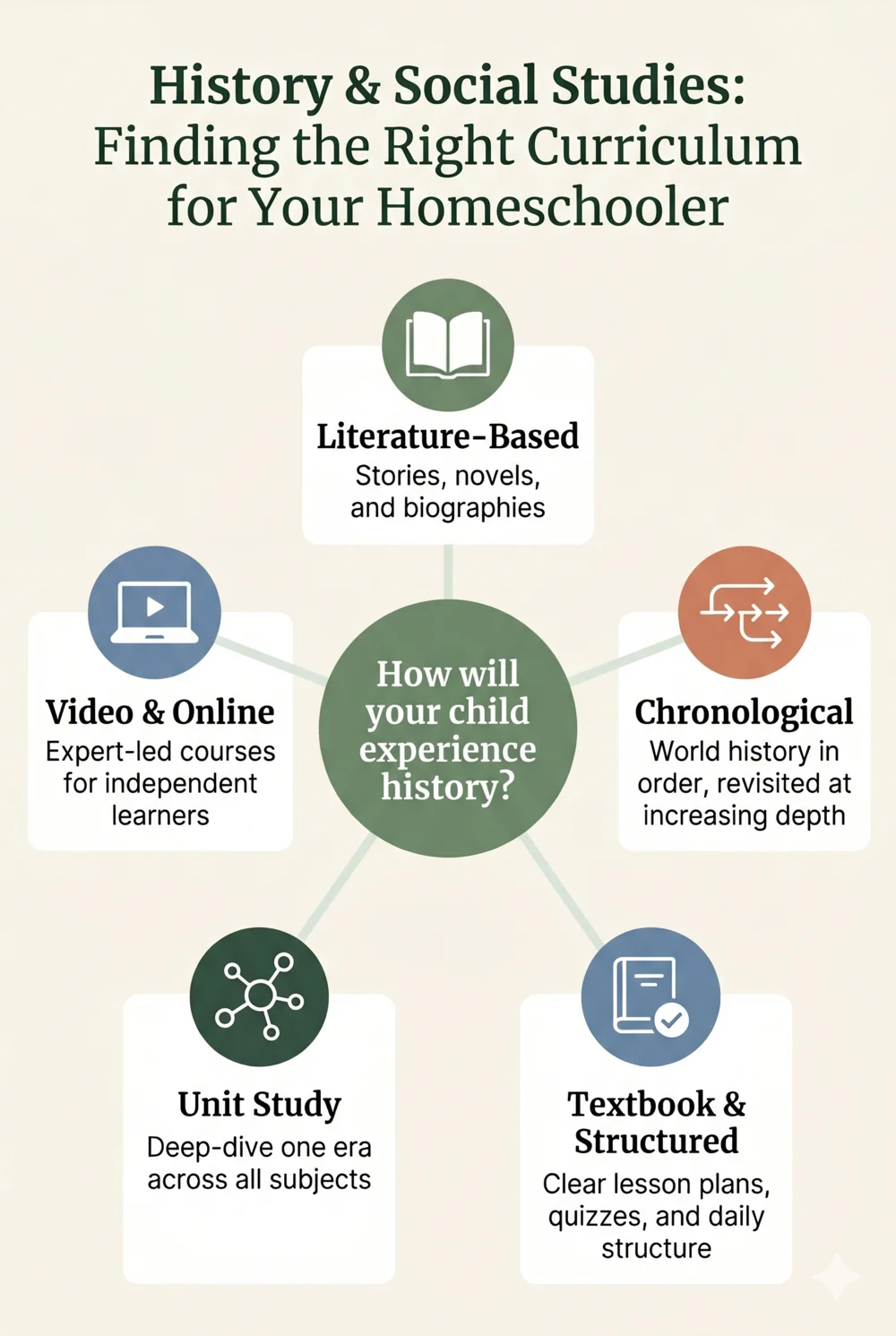
Quick Comparison
| Approach | What It Develops | Grades | Parent Role |
|---|---|---|---|
| Literature-Based / Living Books | Historical empathy, narrative comprehension, cultural awareness | K-12 | High for younger; moderate for older |
| Chronological | Chronological thinking, historical analysis, research skills | K-12 (4-year cycle) | Moderate — structured with parent-led discussion |
| Textbook & Structured | Content knowledge, study habits, grade-level historical literacy | K-12 | Low to moderate — follow lesson plans |
| Unit Study & Project-Based | Cross-curricular connections, research skills, creativity | K-8 (most common) | High — significant prep and facilitation |
| Video & Online Courses | Independent learning, note-taking, analytical writing | 6-12 | Low — mostly monitoring |
History is one of the most worldview-sensitive subjects in homeschool. The same events can be taught from fundamentally different perspectives — a Christian curriculum might begin with Creation and frame history as God’s unfolding plan, while a secular curriculum starts with archaeological evidence and frames history as human-driven. Both approaches are well-represented above. Use the worldview filter to focus on curricula that match your family’s perspective.
Understanding the Approaches
Literature-Based / Living Books
Literature-based history uses real books — novels, biographies, and primary source accounts — rather than textbooks to teach history. Children encounter historical periods through the eyes of characters who lived them, building historical empathy and narrative comprehension. This approach is often associated with Charlotte Mason, a British educator who believed children learn best from “living books” (engaging, well-written works by passionate authors) rather than dry compilations.
Most literature-based programs organize history chronologically and cycle through the timeline every 3-4 years, with increasing depth. Younger children hear read-alouds while older students read independently and write narrations — short retellings in the child’s own words that build comprehension and writing skills simultaneously. Several of the programs below are comprehensive curricula that cover other subjects alongside history — we include them here because their history component is what families seek them out for.
What a week looks like: In a typical week studying ancient Rome, a family might read a chapter from a historical novel set during the Roman Republic, look at a timeline together, discuss why the Republic fell, and have the child retell what they learned in their own words. Younger siblings might color a map of the Roman Empire while an older student writes a paragraph comparing Roman government to modern democracy.
Chronological
Classical and chronological history programs follow a specific timeline through world history — typically Ancient (5000 BC–400 AD), Medieval (400–1600), Early Modern (1600–1850), and Modern (1850–present). Students cycle through this timeline multiple times at increasing levels of depth, a structure called the “history cycle.” In classical education, this maps to three developmental stages: younger children absorb facts and stories through repetition, middle schoolers analyze causes and connections, and high schoolers argue interpretations and write research papers.
This is the dominant approach in classical homeschool circles and is also widely used by non-classical families who simply want a coherent chronological framework rather than the grade-by-grade topic-hopping common in public schools.
What a week looks like: A family in Year 1 of the cycle (ancient history) might read about Mesopotamia from their main history text, locate Sumer on a map, create a timeline entry, and — depending on age — either do a coloring page (young) or read primary source excerpts from the Code of Hammurabi (older). The same family will return to Mesopotamia four years later with deeper analysis.
Textbook & Structured
Textbook and structured history programs provide the most familiar format for families coming from traditional schooling: a textbook with chapters, review questions, and tests. These programs lay out exactly what to teach, when, and how to assess understanding. While “textbook” can sound uninspiring, modern homeschool publishers have significantly improved from the dry school textbooks many parents remember — many now include engaging narratives, full-color illustrations, and integrated activities.
The key advantage is predictability and completeness: you know exactly what your child is learning, whether they’re retaining it, and how they compare to grade-level expectations. This matters for families in states with testing requirements or those planning to transition back to traditional school. Note that this group skews Christian — secular families looking for structured options will find strong choices in the Literature-Based and Video groups.
What a day looks like: A typical day involves reading a textbook chapter (15-20 minutes), answering comprehension questions, and completing a map activity or vocabulary worksheet. Weekly or unit tests verify retention. Some programs include supplemental reading lists for families who want to go deeper.
Unit Study & Project-Based
Unit study programs organize history around deep dives into specific topics, time periods, or themes rather than marching through a textbook chapter by chapter. A unit on the Renaissance might spend 2-4 weeks integrating history, art, science (Da Vinci’s inventions), literature, and writing — all connected to one era. This approach is especially popular with multi-age families because younger and older children can study the same topic at different levels of depth.
The tradeoff is coverage: unit studies go deep but may not cover every historical period systematically. Families who choose this approach often pair it with a timeline to track what they have and haven’t covered.
What a unit looks like: A two-week unit on the American Revolution might include reading historical fiction, recreating a colonial recipe, writing a letter from the perspective of a soldier at Valley Forge, building a model of a colonial town, and debating whether independence was justified. All subjects weave together around the central historical topic.
Video & Online Courses
Video and online history courses deliver instruction through recorded or live video lectures, often by subject-matter experts or engaging presenters. This is the fastest-growing category in homeschool history, driven by parents who need their children to learn independently and by high schoolers seeking transcript-ready courses.
For many working families, video courses are the only practical option for subjects like history where the parent may not feel confident teaching the content themselves. The best programs combine video instruction with discussion prompts, writing assignments, and primary source analysis rather than just passive viewing.
What a day looks like: A student might watch a 15-minute video lecture on the causes of World War I, complete an interactive timeline activity, read a primary source document, and write a short analytical paragraph — all independently. The parent reviews completed work weekly rather than teaching daily.
Curricula by Approach
Literature-Based / Living Books
Chronological
Textbook & Structured
Unit Study & Project-Based
Video & Online Courses
No curated programs match this filter.