
Homeschool Logic & Critical Thinking: A Curriculum Guide
Logic and critical thinking curriculum for homeschoolers ranges from puzzle workbooks for young children to formal symbolic logic courses for high schoolers. Most programs are workbook-based and affordable. The table below shows the main approaches — they build on each other, so many families progress through several over the years.
Worldview matters in this subject. Several popular logic curricula — especially for informal and formal logic — come from Christian classical publishers. "Christian classical" refers to a tradition that combines classical education methods (the trivium of grammar, logic, and rhetoric stages) with a Christian worldview. These programs are widely used and well-regarded, but they are not the only options. Secular and neutral curricula are available for most approaches, and the worldview filter below can help you find them.
This page features 17 editorially curated programs chosen for the quality of their logic & critical thinking instruction. To see the complete catalog, including comprehensive programs that cover logic & critical thinking alongside other subjects, browse all 96 logic & critical thinking-related offerings.
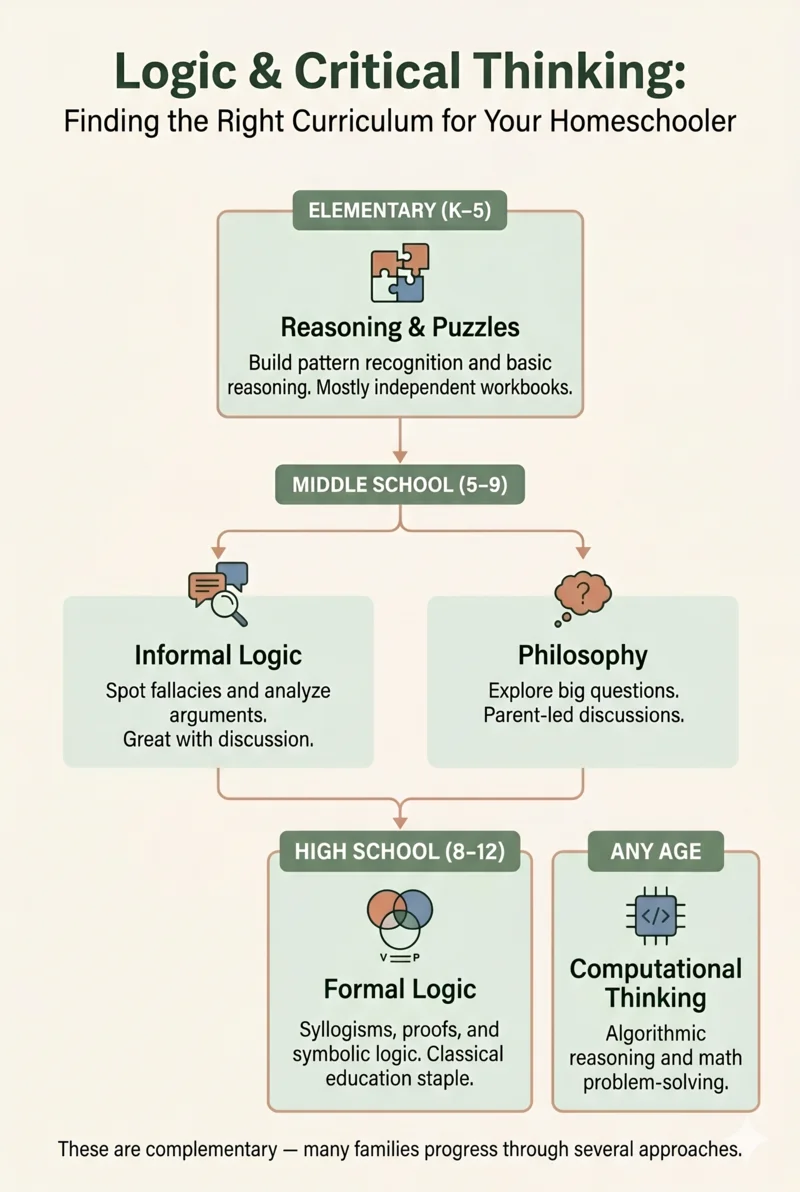
Quick Comparison
| Approach | What It Develops | Grades | Parent Role |
|---|---|---|---|
| Reasoning & Puzzles | Pattern recognition, spatial reasoning, basic inference | K-5 | Minimal — mostly independent |
| Informal Logic & Fallacies | Fallacy identification, argument analysis | 3-12 | Moderate — benefits from discussion |
| Formal Logic | Syllogisms, categorical reasoning, proofs | 7-12 | Low to moderate — textbook + exercises |
| Philosophy & Inquiry | Open-ended questioning, ethics, curiosity | K-12 | High — parent leads discussion |
| Computational Thinking & Problem Solving | Algorithmic reasoning, mathematical problem-solving | 5-12 | Low — mostly self-directed |
| Media Literacy & Information Evaluation | Source evaluation, bias detection, media analysis | 11-12 | Low — mostly self-directed |
These approaches are complementary, not substitutes. Many families start with reasoning puzzles in elementary, add informal logic in middle school, and progress to formal logic in high school. Philosophy and computational thinking can layer in at any point.
Understanding the Approaches
Reasoning & Puzzles
Reasoning curricula build the foundational thinking skills that all other logic depends on: recognizing patterns, completing sequences, drawing analogies, and making inferences from visual or verbal information. Think of it as training your child’s "thinking muscles" before they encounter formal arguments.
What they’ll practice: A typical exercise might show four shapes and ask which one doesn’t belong — and crucially, ask the child to explain why. Or it might present a sequence like "2, 6, 18, ?" and ask the child to find the rule. These aren’t just puzzles — they’re building the habit of looking for underlying structure, which is exactly what logic is.
Informal Logic & Fallacies
Informal logic teaches children to analyze the arguments they encounter every day — in conversations, advertising, news, and social media. The focus is on identifying fallacies: common patterns of flawed reasoning that sound convincing but don’t hold up. This is the most immediately practical form of logic instruction.
What they’ll learn: Your child will learn to spot reasoning like "Everyone’s doing it, so it must be right" (bandwagon fallacy), "You can’t trust her argument because she’s young" (ad hominem), or "We’ve always done it this way" (appeal to tradition). They’ll practice evaluating whether a conclusion actually follows from its evidence, and learn to construct stronger arguments themselves.
Formal Logic
Formal logic is the study of argument structure itself — independent of what the argument is about. Students learn to work with syllogisms (structured arguments with premises and a conclusion), truth tables, and eventually symbolic notation. It’s a staple of classical education and excellent preparation for college philosophy, law, mathematics, or computer science.
What they’ll learn: A syllogism like "All mammals are warm-blooded; all whales are mammals; therefore all whales are warm-blooded" is valid — the conclusion follows from the premises. But "All cats have four legs; my dog has four legs; therefore my dog is a cat" uses the same surface pattern yet is invalid. Students learn to diagram arguments, test their structure for validity, and recognize when a conclusion feels right but the reasoning is actually broken.
Philosophy & Inquiry
Philosophy curricula develop thinking through open-ended questions rather than right answers. Children explore concepts like fairness, truth, identity, and beauty through guided discussion — the Socratic method adapted for young learners. This approach builds intellectual humility and the ability to consider multiple perspectives, which complements the more structured logic approaches.
What a session looks like: A parent might read a short story or scenario — "If you found a wallet with $100 and the owner’s ID, what would you do? What if no one saw you? What if you really needed the money?" — and then guide a discussion. There’s no answer key. The goal is for the child to practice reasoning through ambiguity, articulating their thinking, and genuinely engaging with viewpoints different from their own.
Computational Thinking & Problem Solving
Computational thinking teaches children to approach problems the way a computer scientist would: break complex problems into smaller steps, look for patterns, filter out irrelevant details, and design step-by-step solutions. Despite the name, it doesn’t require coding — though it pairs naturally with programming. It’s increasingly recognized as a core thinking skill alongside reading and math.
What they’ll practice: "How would you give a robot exact instructions to make a peanut butter sandwich?" reveals how much we take for granted in everyday reasoning — the robot doesn’t know to open the jar first. Or: "If you need to find a name in a phone book with 10,000 entries, what’s the fastest strategy?" leads to discovering binary search, a fundamental algorithm. These exercises develop precision in thinking that transfers far beyond technology.
Media Literacy & Information Evaluation
Media literacy teaches students to critically analyze the information they encounter every day — in news, social media, advertising, and online sources. Rather than studying the structure of arguments (like formal logic) or identifying named fallacies (like informal logic), media literacy focuses on a practical question: How do I know if this is true, and who benefits from me believing it?
What they’ll learn: Students practice evaluating source credibility, detecting bias in reporting, understanding how media ownership affects coverage, and distinguishing between fact and opinion. They’ll learn techniques like lateral reading — checking what other sources say about a claim rather than just evaluating the source itself — and learn to recognize common manipulation tactics in digital media.
Free supplement: If you’re not ready for a full course, Stanford’s Civic Online Reasoning lessons offer a free, research-backed introduction to source evaluation.
Curricula by Approach
Reasoning & Puzzles
Informal Logic & Fallacies
Formal Logic
Philosophy & Inquiry
Computational Thinking & Problem Solving
Media Literacy & Information Evaluation
No curated programs match this filter.